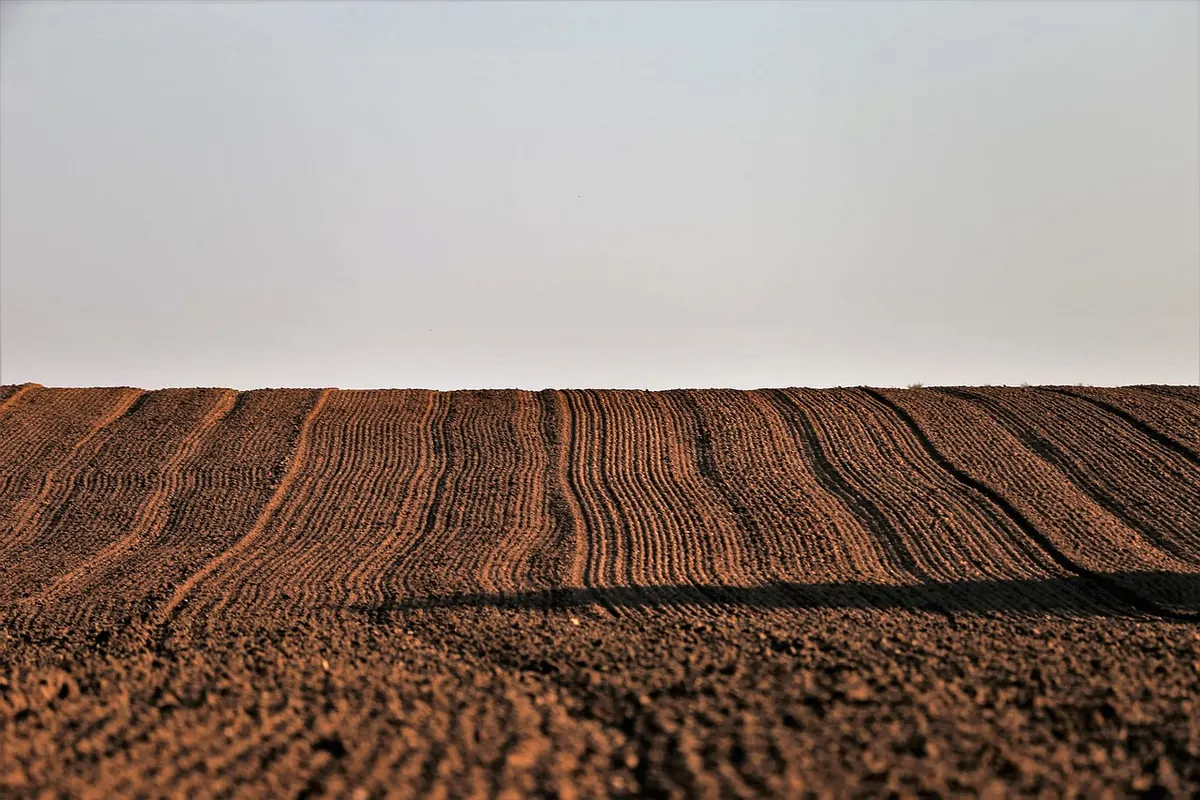
Some of the oldest writing in the countryside isn't in a church register or carved on a boundary stone. It's in the ground itself, in long soft ripples running across a field like the swell left behind by a passing boat. Walk almost any parish in the English Midlands on a frosty morning and you may find them: parallel humps and hollows, sometimes knee-high, sometimes so faint you have to squint along the line of the field to see them at all.
These are the remains of medieval ploughing — ridge and furrow, or "rigg and furr" in the north. Most were made between the eleventh and sixteenth centuries, when villagers farmed together in open fields, and the pattern survives largely because the land was later turned over to pasture and never ploughed again. Once you can read them, a plain grass field turns into a document.
What Ridge and Furrow Actually Is
A medieval plough team — usually oxen, sometimes horses — pulled a heavy mouldboard plough that turned the soil to one side. Working up and down a strip, the ploughman gradually threw earth towards the centre, raising a rounded ridge and leaving a furrow at each side. Repeat that across a whole furlong and you get the corrugated look.
A few features are worth knowing before you go looking:
- Lands or selions: the individual ridges, often about five to ten paces apart, though they can be narrower or considerably wider.
- Furrows: the damp channels between them, which hold water or show darker soil.
- Headlands: strips at the field edge where the team turned, ploughed at right angles to the rest.
- Baulks: occasional unploughed strips left between blocks of land.
- Reversed-S curves: the gentle kink at each end of a ridge where the team swung round — the single most reliable clue.
Where to Look
Ridge and furrow survives best on old permanent pasture, particularly on heavy clay where later ploughing was difficult and expensive. Churchyards, the parkland of former manor houses, village greens and the fields around a shrunken or deserted village are all classic places to start.
It also shows up on arable land, but differently. There you're reading soil marks or cropmarks rather than earthworks. The buried ridges hold and lose moisture slightly differently from the furrows, so a ripening cereal crop grows shorter or paler in bands. From the air, or from a high footpath, that can be startlingly clear.
Two sensible starting points: old Ordnance Survey and tithe maps, which often show the elongated strip shape of former open fields, and your county Historic Environment Record, usually searchable online and full of notes on where earthworks have been recorded.
The Light Does Most of the Work
You will not see ridge and furrow at noon in July. The best conditions are:
- Low winter sun, early morning or late afternoon, raking across the field at a shallow angle.
- Light frost settling in the furrows, or a thin dusting of snow.
- A few hours after rain, when the hollows darken and the ridges dry first.
- Short or grazed grass. Long summer grass hides everything.
If you can only visit once, go on a bright, cold morning in December or January. Stand side-on to the ridges, then walk twenty paces and look again — the pattern often reveals itself from one particular angle and nowhere else.
Sorting It From Modern Ploughing
This matters, because not every corrugated field is medieval.
- Modern ploughing runs straight and parallel, usually with tramlines, and tends to follow the longest side of the field.
- Ridge and furrow is slightly irregular. It wanders to follow the slope, stops short of an old boundary, and changes direction in different blocks.
- Rounded, curling ends and a reversed-S at the headland are the giveaway. Modern work ends in a sharp, straight turn.
- Medieval ridges are often higher and more widely spaced than anything a modern plough would leave behind.
- Where the earthwork is genuine, the furrows run continuous and roughly even, and clearly predate any fence or hedge crossing them.
What the Ripples Tell You
Once you can see the pattern, you can start asking what it means. The spacing says something about the plough and the team — wide ridges take more passes to build. The reversed-S ends show where animals turned. The direction shows how the slope was worked and where water was meant to run. On wet clay, raising the land was as much about drainage as about seedbed.
The layout reveals a shared system. Villagers held scattered strips in large open fields rather than one compact farm, and those strips were reallocated periodically. When populations fell and much arable was converted to sheep pasture, the ploughing stopped. That is why so many of these fields are grass today: the earthworks were frozen in place by the very change that emptied the villages.
Genuine ridge and furrow is fragile. A single season of deep ploughing erases it. Many examples are legally protected as scheduled monuments, so check before you dig, metal detect or remove anything at all.
A Practical Field Guide
- Check the records first. Search your county Historic Environment Record and old maps for recorded earthworks near you.
- Pick pasture, not a freshly ploughed field. Grass holds the shape; the plough destroys it.
- Go in winter, in low sun, after frost or rain. This is not a summer pursuit.
- Approach at an angle. Look across the ridges from the side, then along them, then from higher ground.
- Pace out the spacing. Note whether the ridges are roughly even and how far apart they sit.
- Examine the ends. Look for the reversed-S curve and a headland running crossways.
- Stay on the headland or the edge. These are working fields and livestock pasture, and the earthworks are easily trodden down when wet. Ask permission, close gates, and leave the ground as you found it.
Do that a few times and you will start seeing them everywhere — on the drive to the shops, from a train window, in the field behind the church. A plain green pasture is rarely as plain as it looks.
Photo: GoranH / Pixabay