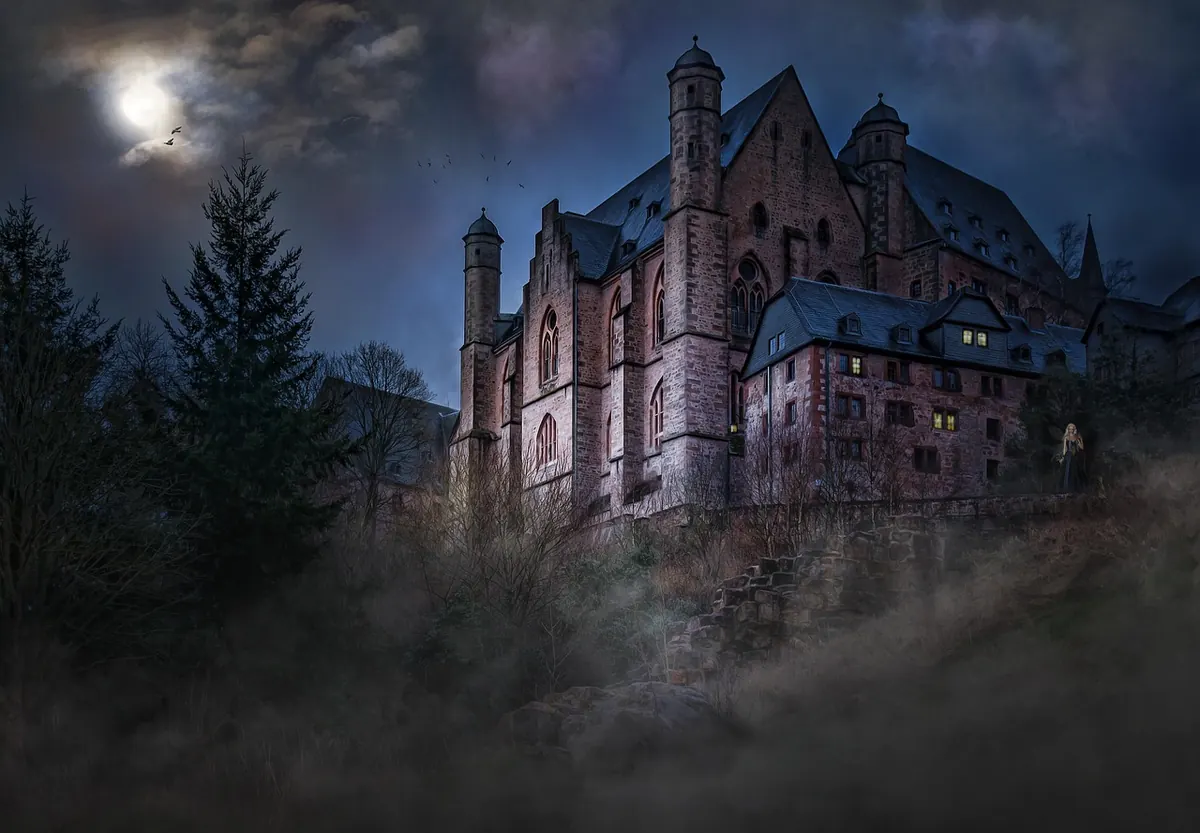
A stone tower stands on a ridge in Worcestershire with no road leading to it. An arch in a Somerset park looks like the last fragment of a medieval abbey, except the mortar is too tidy and the stone too square. A cave in a Surrey hillside is lined with shells, crystals and mirror glass, and was never meant to shelter anyone. These are follies, and the British countryside is full of them.
The word comes from the French folie — foolishness, a whim, an extravagant piece of nonsense. In garden history it means something a little more precise: a building put up for effect rather than use, usually with a wink behind it.
What Actually Counts as a Folly
The useful test is purpose. A barn is a barn. A folly is a structure whose main job is to be looked at, or to make the viewer feel something — surprise, melancholy, grandeur, amusement. That definition is broad, and it has always been a loose label, applied by owners, mapmakers and slightly disapproving neighbours.
Plenty of follies had a small job on the side. A tower might hold one room for tea. A bridge might carry a real track while dressed up as a Roman aqueduct. Dovecotes, ice houses and estate water towers were sometimes disguised as temples or castles, which makes them hybrids: working buildings in fancy dress. A true folly is the one where, if you strip away the ornament, almost nothing is left.
Why Anyone Would Build One
The great age of the folly was the eighteenth century, and the reason is the landscape garden. Designers such as William Kent, Capability Brown and Humphry Repton treated an estate as a moving picture: you walked a route, and the view changed as you went. To make that work you needed incident — a temple at the end of a lake, an obelisk on a hill, a ruined arch glimpsed between trees. Follies were the punctuation marks.
Three other motives show up again and again.
- Memory. Young gentlemen returned from the Grand Tour with heads full of Rome and Athens, and built what they had seen: classical temples, columns, triumphal arches. The Temple of Concord and Victory at Stowe is that instinct in stone.
- Status. Nothing announces money quite like a building you do not need. A sham castle on a hillside said that the owner had cash to spare and taste to argue about.
- Employment. Estate owners sometimes kept local labourers busy through lean seasons by commissioning ornamental work. The result was a folly and a wage packet.
Later centuries kept the habit. Victorian and Edwardian owners built towers, garden buildings and memorials with the same love of surprise, and the fashion only really faded in the twentieth century. Faringdon Folly in Oxfordshire, raised in the 1930s for Lord Berners, is often called the last traditional folly built in England.
Towers, Ruins and Grottoes: A Field Guide
Tower follies
Almost always on high ground, and usually thinner than a working tower would be. Inside you often find a spiral stair, a single chamber, and windows placed for the view rather than the room. Broadway Tower in Worcestershire is said to have been built so that its owner could test whether a beacon fire on the hill would be visible from his house. King Alfred's Tower, on the Stourhead estate in Wiltshire, is a triangular brick giant of the 1770s. Clavell Tower in Dorset was dismantled and rebuilt further back from the cliff edge in 2006, which tells you something about how seriously these odd buildings are now taken.
Sham ruins
Ruins built deliberately broken. The telltale signs are neatness and isolation: crisp broken edges, walls of even thickness with no sign of collapse, no floor levels, no spread of rubble, and no village, church or road to explain what the rest of the building was. Real ruins come with messy archaeology. Sham ruins come with a landscaped view and a convenient bench. Sham Castle, on the hillside above Bath, is a good example of the type.
Grottoes
Caves that were built rather than found. Look for shellwork, tufa, crystals, coral, mirror glass and a brick vault hiding behind the decoration. The crystal grotto at Painshill in Surrey and the grotto at Stourhead in Wiltshire are among the finest, and Pope's Grotto at Twickenham was famously lined with minerals and shells. Expect damp, dark, uneven floors and a temperature that feels ten degrees colder than the car park.
Everything else
- Eye-catchers: built purely to close a view or sit on a skyline, sometimes with no interior at all.
- Temples and pavilions: classical fronts, columns, pediments, often a single room for picnics and conversation.
- Obelisks and columns: tall, thin, cheap to build and very effective against a sunset.
- Hermitages and root houses: rustic retreats built from branches, roots, moss and bark, intended to look grown rather than made.
- Shell houses: small buildings with interiors entirely encrusted in shell patterns, a seaside fashion that spread inland.
How to Read One in the Field
- Read the approach. If a building has no sensible path, no yard and no service access, ornament was probably the point.
- Read the stonework. Hand-cut stone, thin eighteenth-century brick and reused material from an older building all give clues to date.
- Look for the quarry. Many follies sit close to the pit the stone came out of, which is often why they were placed where they are.
- Check the map. Names such as The Folly, Sham Castle, Prospect Tower, Temple or Grotto are strong hints, and old large-scale maps show them clearly.
- Test the scale. Interiors too small for furniture, doors too narrow for a sack barrow and stairs too steep for daily use are all giveaways.
- Turn around. Position is the point. From the folly, look back at the house or the lake — the building was placed for that sightline.
A Few to Start With
- Stowe, Buckinghamshire: temples, a Palladian bridge and a landscape packed with incident.
- Painshill, Surrey: a grotto, a Turkish tent and a vineyard, all arranged along a walk.
- Stourhead, Wiltshire: the grotto, the Pantheon and King Alfred's Tower on the wider estate.
- Hawkstone Park, Shropshire: follies, caves, cliffs and a landscape built for wandering.
- Broadway Tower, Worcestershire: a hilltop landmark with a long view and a small museum inside.
- Faringdon Folly, Oxfordshire: a twentieth-century tower on a wooded hill, open on limited days.
Follies on Foot: Practical Notes
Most follies stand on private land or working farmland, and many are simply meant to be seen from a distance. That is fine — often the view is the visit. Plan around public footpaths and open access land, and check before you set out whether the site belongs to the National Trust, the Landmark Trust, a local trust or a private owner, because opening arrangements vary widely and some grottoes open only on guided tours.
On the day: stay on rights of way, close gates behind you, keep dogs on leads near livestock, and resist the urge to climb. Old masonry is unstable, and many of these structures are scheduled monuments protected by law. A torch helps in grottoes, boots are
Photo: Tabor / Pixabay