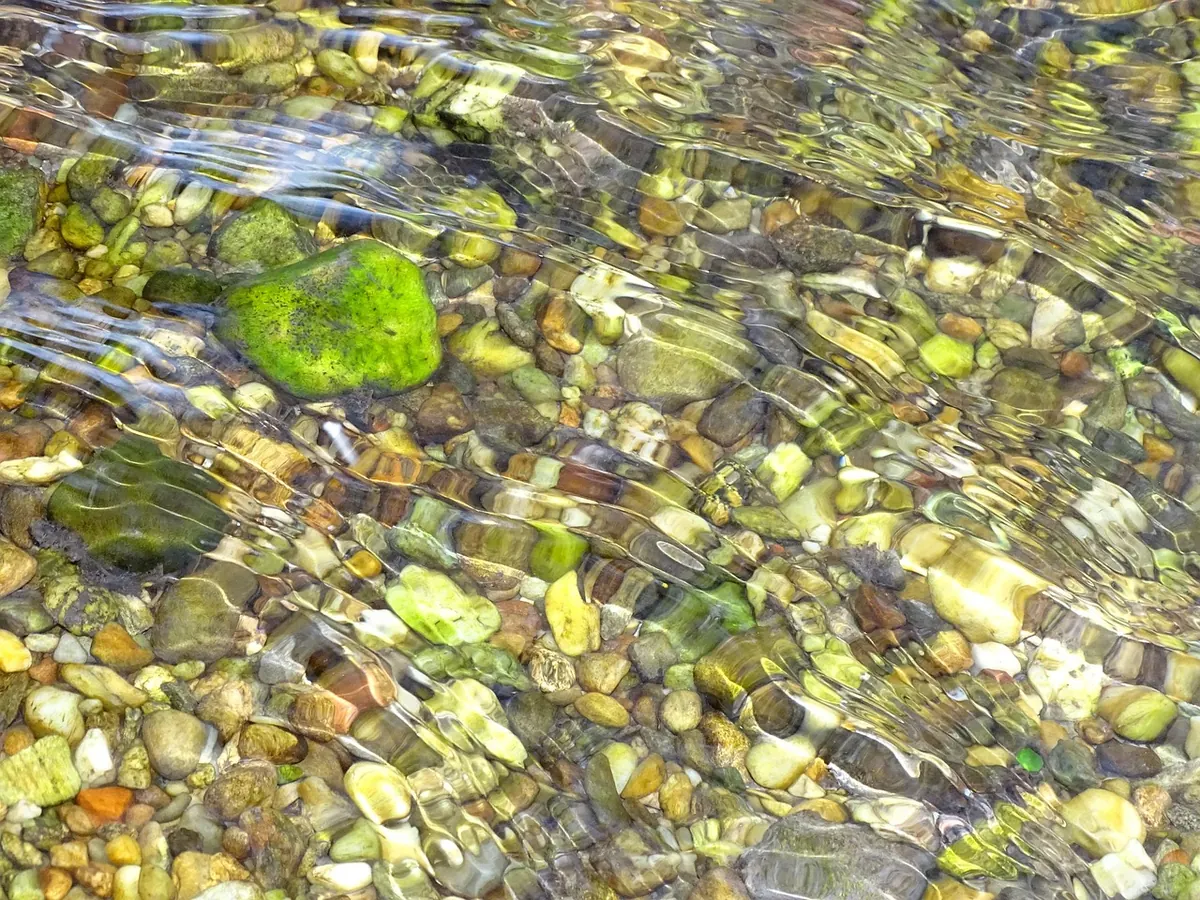
Most lowland rivers carry a haze of silt, stirred up by every downpour and every passing boat. A chalk stream does not. Stand on the bank of one in Hampshire, the Chilterns, Norfolk or the Yorkshire Wolds and you can count the pebbles on the bed, watch a mayfly nymph crawling over a leaf, and follow a brown trout with your eyes long before it notices you. That clarity is not luck. It comes from the rock underneath the river, and it explains almost everything else about the wildlife living there.
What makes a chalk stream a chalk stream
Chalk is a soft, white limestone laid down on the floor of a warm sea roughly a hundred million years ago, built mostly from the plates and shells of microscopic marine algae. It is porous and heavily fractured, and that matters more than its chemistry. Rain falling on chalk hills soaks straight in rather than running off the surface, then travels down through cracks and fissures over weeks, months or years.
A chalk stream, in other words, is mostly groundwater come back into the daylight. Its water arrives from springs — often at the foot of a slope, sometimes welling up through the gravel of the riverbed itself — rather than from surface drainage. Some chalk streams have upper sections, called winterbournes, that flow only after a wet winter and shrink back to a line of damp gravel in summer.
The chalk is a slow, very fine filter
Any water pushing through soil and rock surrenders most of what it is carrying. The chalk's tight network of narrow fissures traps fine particles. By the time the water reaches a spring, the silt, clay and organic debris it picked up at the surface has largely been left behind. What emerges is mineral-rich but particle-poor — and particles are what make water look murky.
There is a second reason chalk streams stay clear for miles downstream. Because so little of the flow comes from surface runoff, far less soil washes off fields into the channel. The flow is also remarkably steady: groundwater moves at a slow, even pace, so the river does not lurch up and down after every storm the way a clay or spate river does. Steady flow means banks are less likely to crumble, and less eroded bank means less silt.
Cold, steady water holds more oxygen
Groundwater sits at roughly the average annual air temperature of the place where it fell. Chalk stream water therefore hovers near ten degrees Celsius all year — cool in summer, comparatively mild in winter. Cold water holds more dissolved oxygen, which suits stoneflies, mayflies and trout, and the stable flow means gravel beds are not scoured out each winter. Insects can spend a year or two as larvae without being flushed away.
Clear, alkaline, and short of nutrients
Clarity is physics; richness is chemistry. Chalk water is alkaline, usually somewhere around pH 7.5 to 8, and carries plenty of dissolved calcium and bicarbonate. It is also naturally low in the nutrients that fuel algal blooms, phosphate and nitrate in particular.
That combination produces a very specific kind of river. Because nutrients are scarce, the plants that thrive are rooted ones growing in the channel rather than planktonic algae suspended in the water itself. There is no green soup. Sunlight reaches the gravel, water crowfoot and starwort grow in long ribbons through the current, and the whole food web builds upward from those beds instead of from murk.
What clear water lets you see
Take a slow walk along a good stretch in late spring and the water becomes a window. Look for:
- Water crowfoot — trailing, divided leaves streaming downstream like hair in a breeze, with small white flowers held above the surface in May and June. The plant is a nursery for invertebrates and shelter for small fish.
- Freshwater shrimp, scudding sideways across stones and weed, plus mayfly and caddis larvae on the undersides of gravel and leaves.
- Brown trout and grayling, holding position in the current and almost invisible until they move; smaller fish such as bullhead, minnow and stickleback hover near the margins.
- Birds and mammals reading the same water you are: grey wagtails on the shallows, herons stalking, kingfishers low and fast, and occasionally an otter or a water vole working the bank.
None of this is visible in a silty river, however healthy it may be. Clarity here is not decoration; it is what allows light to reach plants, plants to shelter insects, and insects to feed fish.
When a chalk stream loses its clarity
Clear water is not automatically healthy water, and the two things that muddy a chalk stream most often come from land and drains rather than from the river itself. Fine sediment from compacted fields, road runoff and trampled banks clouds the gravel and smothers the spaces between stones where invertebrates live. Phosphate from treated sewage and farmland does the opposite of what you might expect: the water can still look glassy while algae fur grows over the crowfoot, and the river quietly loses its character.
Low flows are the third pressure. Chalk streams depend on water that fell as rain and percolated down, so heavy abstraction in a dry year shows up as exposed gravel and stagnant margins. A chalk stream can be beautiful and still be struggling.
How to look at one properly
Choose a stretch you are allowed to be on: public footpaths, riverside nature reserves and Wildlife Trust sites are the safest bets. Many chalk streams run through private land or fishing beats, so treat a fence or a "no entry" sign as final unless you have asked.
Timing matters more than gear. Late May into June is the best window, when crowfoot is flowering and the water is still high enough to look lively. Go early in the day; a low sun rakes across the surface and picks out fish shadows that vanish at noon. Cheap polarised sunglasses, the kind sold for fishing, cut surface glare and make the bed appear where there was only sky a moment before.
Then slow down. Kneel at a shallow riffle and look upstream, letting your eyes adjust for a full minute before deciding there is nothing to see. Stay out of the channel: those gravels are spawning grounds, and boot prints last. Keep dogs out of the water for the same reason, and if you want to go further than watching, look for a local riverfly monitoring group — volunteers sample invertebrates a few times a year, and the method is straightforward to learn.
Photo: LeahReiter / Pixabay